Guides / Done for you
AI receptionist for multiple locations: a call plan
By Next Gen Calls · Published
Quick summary
We build, connect, launch and tune your AI receptionist around the branches your customers use. For multiple locations, agree how the caller's intended branch is established, which local facts apply and where the request goes. Then test a caller changing that choice halfway through the conversation.
- 01 →
Establish the intended branch
Use the caller's words and the agreed phone-entry context; clarify an uncertain location.
- 02 →
Use that branch's facts and team
Check its approved hours, service scope and receiving destination.
- 03
Follow a correction to the outcome
Verify that the final answer, handoff or open request reflects the corrected location.
Illustrative workflow. We confirm the connected actions and permissions for your setup before launch.
Start with the branch the caller means
Two locations can share a name while offering different services, hours and people to speak with. A friendly answer still creates work if it sends a customer to the wrong counter.
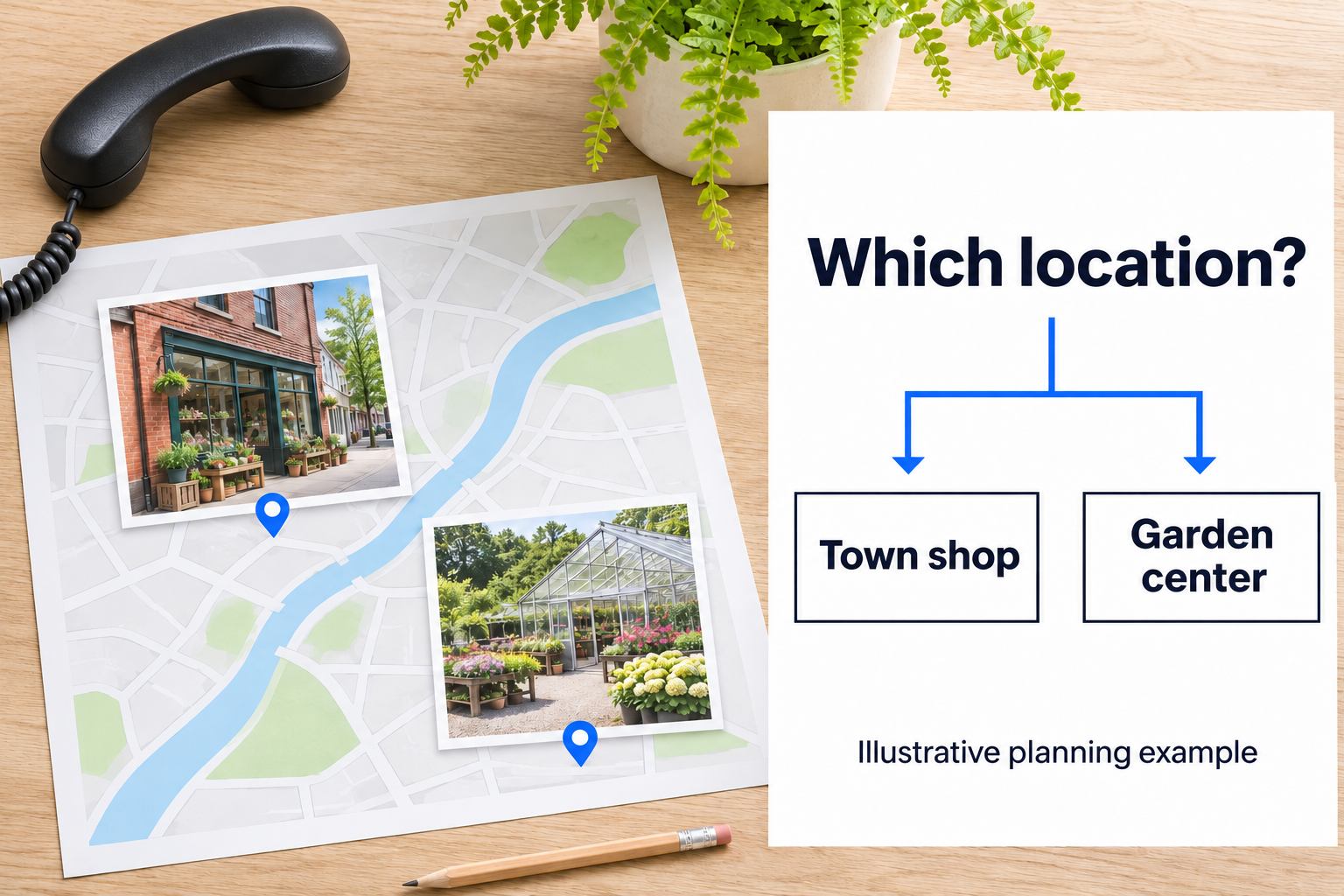
Start the build with the places customers recognize: “town shop” and “garden center,” for example. Include common descriptions such as “the one by the station.” Agree what the receptionist should do when a description could mean either place.
The number dialed can be a useful clue, depending on the supported phone setup. It is not a reason to ignore “I need the other location.” Keep the phone entry, the caller's intended branch and the team handling the request as separate decisions until they have been confirmed.
Smart Receptionist Agent™ can answer approved business questions, capture requests and warm-transfer callers. We agree the supported scope for your locations and connections during the build. We do not assume every branch shares a calendar, customer record or set of permissions.
Bring a short fact sheet for each location
Give us the differences that change an answer or next step:
- Customer-facing name: Include the branch name and familiar local descriptions. Avoid making callers learn an internal location code.
- Visit details: The actual address, useful entrance directions and any distinction between a collection point and a service location.
- Approved services: What that branch handles, and which requests need another team. A service listed for the whole business may not be available at both counters.
- Hours and exceptions: Customer-facing hours, time zone and approved holiday changes. Keep these separate from the availability of staff receiving calls.
- Receiving team: The agreed handoff destination, unanswered outcome and person responsible for open requests.
- Update owner: Who confirms a changed fact, when it takes effect and which other location information needs review.
Google's business representation guidelines distinguish information for an individual location and customer-facing operating hours. Check your approved branch sheet against what customers see on your website and business profile. A correction to the receptionist's information does not establish that those public listings changed too.
The knowledge-base guide explains how to prepare approved answers and handle information the agent cannot establish. For this build, the extra decision is which branch each answer belongs to.
Keep the local answer and staff route together
Knowing that the garden center is open is different from knowing that its receiving team can take a call. Agree both parts of the journey.
For each branch, name the staff destination and the actual backup or message outcome. Smart Receptionist Agent™ supports warm transfers with a private briefing, plus configured backup and voicemail fallback. Use the human-handoff plan to agree what staff need to hear before connecting.
If a branch is closed, decide which requests can be taken for later review and which may go to an agreed alternative. Do not silently turn a request for one location into a booking or promise at another. A caller may have a reason to choose that particular place.
Use the holiday-hours plan for exceptions. Test a day when the locations differ, rather than only testing both while open.
Follow a corrected location through one call
Here is a fictional plant-shop example. Its approved example plan says the town shop is closed on Sunday and the garden center is open from ten to four. These are illustrative facts, not the hours of a real client.
Receptionist: Thanks for calling the plant shop. How can I help?
Caller: Are you open on Sunday?
Receptionist: Do you mean the town shop or the garden center?
Caller: The garden center.
Receptionist: The garden center is open from ten to four on Sunday.
Caller: Actually, I meant the town shop. I need to collect an order.
Receptionist: The town shop is closed on Sunday. Would you like me to take a message for that team?
The correction changes the useful answer. It also changes who should receive an accepted message. It does not establish that the order is ready, move the order to the garden center or promise that somebody will reopen the town shop.
Check three points after rehearsing that call:
- Answer: The final local information describes the town shop. The earlier garden-center hours have not been presented as town-shop hours.
- Next step: Any agreed handoff or message goes to the team responsible for the town-shop request. If no action succeeded, the caller hears the actual remaining step.
- Record: The call summary and open request make the final branch and collection question clear. Staff can distinguish the correction from a second separate request.
Ask for the one missing detail needed for the next step. Do not restart the whole intake simply because the caller corrected a location.
Rehearse the differences before launch
Use a small set of calls with deliberately different branch facts:
- A named branch: Ask the same local question about each location. Compare both answers with the relevant approved sheet.
- No branch named: Ask “Are you open?” without giving a location. Check the agreed clarification instead of accepting whichever hours sound plausible.
- A correction: Begin with one branch, then name the other. Check the final answer, actual receiving destination and summary together.
- One unavailable team: Choose a case where a branch is closed or its staff cannot answer. Observe the agreed backup or message outcome; an attempted transfer is not a connected call.
If a call includes booking, check the actual appointment location separately. A request to use the other branch is not proof that an existing booking changed. Agree the permitted action and staff-review path for that situation.
Keep the observed result and correction owner beside each test. We use those concrete differences to tune the build so the caller's intended location stays clear from the first question to the team's next action.
Common questions
Can we use AI reception for a business with two locations?
We review the branches, phone routes, approved information and receiving teams before agreeing the build. The supported arrangement may need different agents or connections. Do not assume one shared number automatically supplies every location's information, calendar or staff route.
Should the number dialed decide which branch the caller means?
It can provide useful entry context when the supported route supplies it, but a caller may have dialed one branch while asking about another. Agree how the receptionist uses the caller's stated location and when it should ask a short clarifying question. Test the actual phone arrangement.
What if the locations have different opening hours?
Keep each branch's approved customer-facing hours, time zone and exceptions clear. Separately agree when its staff can receive a transfer and what happens if they cannot answer. An open shop does not establish that a particular person is available, and one changed schedule does not automatically update every connected system.
What should happen when a caller changes their preferred location?
Confirm the corrected branch and check the local answer, receiving team and final request against it. An appointment already created at the first location needs its own permitted change process; mentioning another branch does not prove the appointment moved. Test the recorded outcome as well as the spoken response.
Can the receptionist choose the nearest branch?
Agree the supported way to help a caller choose, such as approved area descriptions or asking which named location they prefer. Do not assume the agent has live distance, travel-time, stock or cross-branch availability information. Requests outside the agreed information should have a clear staff-review path.
How do we test that calls reach the correct location?
Use calls naming each branch, a call with no location, a mid-call correction and a case where one branch is closed or staff cannot answer. Compare the final branch with the answer, actual handoff or message, and call summary. Record any mismatch and who owns the correction before approving that path.