When should an AI receptionist transfer a call?
By Next Gen Calls ·
Short answer
Next Gen Calls builds, connects, launches and tunes your AI receptionist, including its route to your staff. Plan a human handoff when a caller asks for a person, needs a decision your team has kept, or cannot get a reliable answer from the approved information. Name the recipient, the private briefing and the backup path before launch.
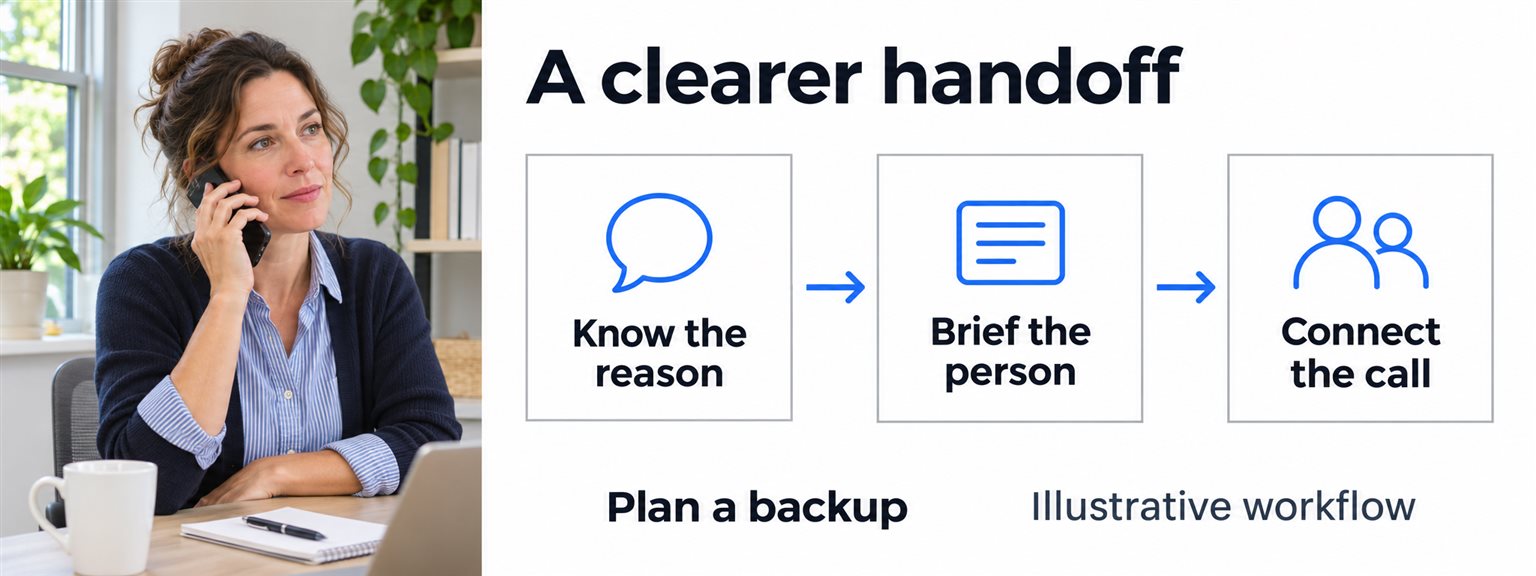
Start with the calls your staff already step in to handle
Ask the person who answers your phone: which conversations do you pass to the owner, manager or another colleague? Those everyday decisions are a useful starting point for your AI receptionist.
Write down a few clear situations:
- The caller asks for a person. Give that request a direct route. Do not make the caller complete a sales conversation to earn a handoff.
- Someone needs to approve a decision. A disputed charge, a refund request or an exception to your usual policy belongs with the person who has that authority.
- The available information is not enough. An uncertain customer match or an unanswered question needs an honest next step, rather than a confident guess.
- Your team has reserved a call type for staff. For example, an existing customer's complaint may go to the office manager, while an ordinary opening-hours question can use your approved answer.
These are rules to agree for your build, not a claim that every difficult conversation can be recognized perfectly. Use examples of what callers actually say, including requests that do not use the word “transfer.”
Make a handoff plan your staff can use
A list of phone numbers is only part of the plan. For each situation, fill in these details with your team:
- The reason: what should make this call reach a person?
- The recipient: which role should receive it, and which contact is approved?
- The hours: who is available during business hours, after closing and on holidays?
- The essentials: what does the recipient need to know before speaking?
- The backup: who gets the next attempt if the first contact is unavailable?
- The remaining step: if nobody answers, what message can the caller leave, and who on your team owns reviewing it?
Use roles as well as names when planning. “The manager” is not a complete route if that person is away and nobody knows who covers them. Keep the contact list current when shifts or responsibilities change.
Google's Agent Assist overview describes a human handoff as a separate stage of a support conversation. The useful business lesson is to plan that stage deliberately, rather than treating an attempted transfer as a completed resolution.
Example: a caller needs a decision about completed work
Imagine an existing customer calls to question a service charge. This is a fictional example, not a customer result.
The caller says, “I need the office manager to look at this.” The agent should follow the agreed person-request route and gather only the essentials needed for that handoff. It should not argue about the charge, negotiate a discount or say a refund has been approved.
If the manager is available, a warm transfer gives them context before the caller joins. If they are unavailable, the approved backup or voicemail path applies. The customer should be told what is happening now, without a callback deadline your staff have not accepted.
The same principle applies to an uncertain booking or an existing-job question: pass along what is known, make uncertainty clear and keep the decision with the right person.
Give the recipient useful context before connecting
A warm transfer includes a short private whisper briefing. Keep it focused on the reason the person is receiving this call.
An illustrative briefing might be:
“This is an existing customer asking the office manager to review a service charge. They have confirmed a callback number. No adjustment has been promised.”
Useful details can include the caller's stated reason, the information collected, what remains uncertain and whether any next step was actually confirmed. Agree which details may be shared for your business. More personal information does not automatically make a better briefing.
The private briefing happens before the recipient is connected. The AI summary after the call is a different item. During testing, check both: the person should understand why they are joining, and your team should be able to review what happened afterward.
Plan for an unanswered transfer
A person-request route needs a fallback that works when staff are busy. Next Gen Calls supports a backup group and then voicemail fallback, with routing by business hours and holidays. We confirm the contacts, timing and wording for your setup.
Decide what the caller should hear when no one is available. For example, approved wording might explain that the team is unavailable and invite a message with a callback number and the reason for calling. That is an illustration to adapt, not a promise about a particular automatic message or a guaranteed callback.
Keep the outcome clear:
- A transfer attempt is not the same as a person answering.
- A voicemail is not the same as a staff member accepting the request.
- A callback request is not a confirmed callback appointment.
- A captured question is not an approved refund, estimate or booking change.
For a trade business, the home-services intake guide shows how this distinction also applies to job requests and after-hours calls.
Test the handoff paths, including the awkward ones
Before launch, make test calls with your team and listen for the result of each route.
- Ask for a person immediately. Check that the agreed handoff path is used without an unnecessary sales conversation.
- Ask for an exception. The request should reach the authorized role without an invented approval.
- Give incomplete or uncertain details. Check that the briefing labels what is unknown instead of presenting a guessed customer match.
- Leave the first contact unanswered. Test the backup group and the final fallback, rather than testing only a successful transfer.
- Call outside normal hours and on a configured holiday. Confirm the route and wording match the coverage your team actually provides.
Compare the AI summary with the test caller's words. Ask the receiving staff member whether the private briefing helped them start the conversation. Fix unclear ownership, wrong destinations or misleading wording before relying on the route for real callers.
Supervisor listen and takeover are also available. We scope that oversight separately from a transfer, so your staff understand which action they are using.
We build the route around your team
Bring your usual call examples, staff contacts, hours, holidays and decisions that must stay with a person. We build, connect, launch and tune the AI receptionist around that plan, then use your feedback to improve it.
For the wider setup, see the next-generation contact-center guide. If you are choosing which support job to handle first, start with virtual agents for customer support.
A friendly note: have your team approve privacy, consent and recording wording for your business.
Frequently asked questions
When should an AI receptionist pass a caller to a person?
Plan a handoff when the caller asks for a person, a request needs authority or judgment reserved for staff, or the approved information is not enough to give a reliable answer. We build the routing around the situations and contacts your business approves.
Does a warm transfer include a private briefing?
Yes. Next Gen Calls supports a warm transfer with a whisper briefing before the receiving person is connected. Agree which useful details belong in that briefing and test that it describes the request without guessing or promising a decision.
What happens if the first person does not answer?
We can configure a backup group and then voicemail fallback, with routing by business hours and holidays. Agree the available contacts and caller wording for your build. A callback request must not be presented as a promised callback time your staff have not accepted.
Can the AI approve a refund or make an exception?
This handoff plan keeps refunds, discounts and exceptions with the authorized people in your business. We do not claim automatic refund approval or price negotiation. Tell us which decisions require staff so the caller receives an honest next step.
Can a supervisor listen and take over?
Supervisor listen and takeover are available. That is a separate option from transferring a call to another recipient. We confirm how your staff will use oversight and routing in the workflow we build for you.